Editor’s Note: This interview has been edited for length and clarity.
Watchman Nee remains one of the most influential Chinese Christian thinkers of the twentieth century. His writings have shaped generations of Chinese Christians and have traveled far beyond China through translation, local church networks, and evangelical, Pentecostal, and charismatic circles around the world.
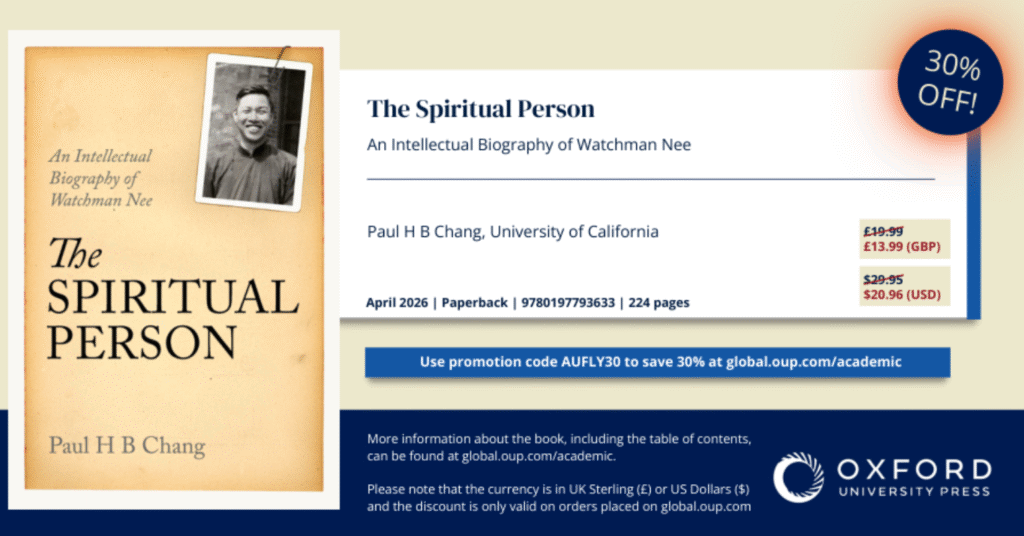
Yet Nee is also a contested figure. He has been described as mystical, anti-intellectual, anti-denominational, and difficult to place within familiar Western theological categories. In his forthcoming book, The Spiritual Person: An Intellectual Biography of Watchman Nee, Paul H B Chang, Associate Professor in the Department of the Study of Religion at the University of California, Riverside, seeks to move beyond such labels and examine Nee’s life, thought, and influence in their Chinese and global Christian contexts.
The book was published by Oxford University Press in April 2026.
Why did you decide to write about Watchman Nee?
I grew up in this tradition. There are three or four generations in my family connected to the local churches, so I experienced Nee’s influence firsthand. But I also saw how far his influence extended beyond my own community.
To me, Watchman Nee is certainly the most influential Chinese theologian, both in the Chinese-speaking world and especially outside of it. His writings have reached an international audience in a way that very few Chinese Christian thinkers have. Yet compared with other major Chinese thinkers, not nearly enough has been written about him.
There are many books on Confucius, Laozi, and Mao Zedong. But Watchman Nee, who is in their company as far as Chinese thinkers who have reached international audiences, is still understudied, especially in English. That is one reason I wanted to write this book.
Your book is called The Spiritual Person: An Intellectual Biography of Watchman Nee. Some people have called Nee anti-intellectual. How do you respond?
I do not think the label is fair. If we look at the volume of writing Nee produced, we see a coherent and comprehensive theological system. He was careful with words, and he studied Greek and Hebrew. He certainly recognized the limits of human reason, but that is not the same as rejecting the life of the mind.
Nee’s mysticism is not anti-intellectual. His teachings are deeply rooted in international evangelical traditions and in the longer history of Christian thought. He was subtle in how he understood the role of the mind, logic, and reason in the spiritual life.
Part of the problem is that Nee’s followers—and I would also include some followers of Witness Lee—have sometimes interpreted Nee and Lee’s teachings in narrow or closed-minded ways. But that happens in many religious traditions. One of my goals in the book is to go back to the source and ask what Nee actually wrote.
Nee is often described as mystical. Some critics have connected his thought to Daoist or Buddhist mysticism. Is that fair?
Nee is certainly a mystical thinker, and mystics have frequently been criticized or feared for being anti-intellectual. In Nee’s case, I think it is a stretch to say that he was introducing Daoist or Buddhist mysticism into the church.
There are parallels among mystical traditions across religious boundaries, of course. But Nee was clearly reading Christian authors and working from Christian evangelical sources. I am comfortable talking about parallels, but I would not say that Nee’s theology is rooted in Daoism or Buddhism.
There can also be a colonial mentality in the way people talk about this. Sometimes anything “Chinese” is treated as suspicious, as if it must be syncretistic in a negative sense. To give an obvious counterexample, the thought of Thomas Aquinas is far, far more Aristotelian than Nee is Daoist, but few people accuse the Roman Catholic Church of introducing Greco-Roman Paganism to Christianity. From the perspective of world Christianity, the gospel has always taken shape within cultures. That is not a weakness of the Christian faith but a sign of its ability to be expressed across the full diversity of human nature.
One of Nee’s best-known themes is the denial of the self. How should Christians today understand that?
This is one of the most powerful parts of Nee’s theology, but also one of the most easily misunderstood.
Nee was deeply concerned with the problem of the self—self-assertion, self-confidence, self-pride. In our age of social media and self-promotion, I think his voice is especially important. He would be very critical of the way even Christians can absorb a culture of self-glorification.
At the same time, Nee should not be read as promoting self-abuse or harsh self-treatment. He is calling Christians to bear the cross. That can be misapplied, but the core insight is still important: the Christian life is not about enthroning the self.
Nee’s view of the church has also been controversial, especially his rejection of denominations. Was he simply anti-denominational?
He was against denominations, but I think we need to understand where he was coming from.
Nee recognized that Christians have real theological differences. But he questioned whether those differences justify dividing the church under different names. He took seriously Paul’s criticism in 1 Corinthians of believers saying, “I follow Paul” or “I follow Apollos.”
I also think this is where Nee’s Chinese context may be an enlightening parallel. In Chinese thought, names are important. The Confucian idea of the “rectification of names” shows how seriously names shape reality and relationships. Nee noticed the importance of the “name of the Lord” in both the Old and New Testaments and argued that attaching denominational names to the body of Christ was not a small matter.
That does not mean everyone has to agree with him. But it helps us see that his ecclesiology was not simply a reaction against Western denominations. It came from a deeper theological, biblical, and cultural concern about the unity of the church.
How would you describe the local church tradition that developed from Nee’s ministry?
In the book, I describe it as having evangelical, Pentecostal, and charismatic elements, though I use those terms broadly.
The local churches are not Pentecostal in the usual American sense. They do not typically emphasize public speaking in tongues, for example. But Nee was not a cessationist. The tradition has been open to healings, miracles, and the work of the Spirit.
At the same time, many people in the local churches do not want to be called charismatic, Pentecostal, Reformed, Protestant, or even given any label at all. That reflects Nee’s suspicion of names. They do not want a label that separates them from the rest of the body of Christ.
How should we understand Witness Lee’s role in carrying forward Nee’s influence?
Witness Lee was very loyal to Watchman Nee’s thought. Based on what I have heard from many eyewitnesses in the local church tradition, Lee hoped to hand leadership back to Nee after Nee’s return from imprisonment. Even after Nee’s death, Lee continued to honor and expound Nee’s teachings.
Of course, Lee also introduced theological and ecclesial developments of his own. One example is the practice of “calling upon the name of the Lord,” which he promoted in Taiwan and the United States. When it was re-introduced to mainland China, this practice became controversial and contributed to divisions.
But we should view these practices in a global Christian context. Loud prayer, shouting, and embodied worship are not unusual in many African or Pentecostal churches. Sometimes what looks abnormal to one cultural tradition is very normal to another.
Because of circumstances that were unique to China, certain groups emerged after contact with Nee and Lee’s teachings including the Shouters, the Anointed King, and Eastern Lightning / The Church of Almighty God. Apart from the Shouters, Lee condemned these groups as cultic or heterodox once he became aware of them.
In the United States, some of the controversies around Lee and the local churches were connected to Christian infighting, especially among young people on college campuses. Those controversies seem to have reached their height around the 1970s. I think it is important to remember that many of these are older controversies from a particular historical moment.
What do you think Watchman Nee’s message is for Christians today?
Nee’s central message is that God has given us a spirit. If someone is uncomfortable with that word, they can use another term. But the point is that there is something in us created for union with God.
1 Corinthians 6:17 says that the one who is joined to the Lord is one spirit with him. Nee wants Christians to pay attention to that union. The more we live from our union with God, the more we express God’s will on earth and glorify him. This life will inevitably lead us to serve the mystical body of Christ, that is, the church.
That is the heart of Nee’s theology: the Christian life is not just moral behavior, doctrine, or participation in the church as an institution or set of practices. It is life in union with God for the church as the corporate life of Christ expressed in human beings.
What do you hope this book contributes to Chinese Christians and the wider church?
For Chinese Christians, I hope the book helps us see Watchman Nee as part of our shared Christian and cultural inheritance. He was born under the Qing Empire, lived much of his life as a citizen of the Republic of China, and died as a citizen of the People’s Republic of China. In that sense, he belongs to all Chinese people, not only one political or ecclesial group.
But Nee also belongs to the wider church. His writings have influenced Christians far beyond China. What has been missing is a comprehensive English-language treatment of his life, thought, and influence.
I hope this book introduces Nee to a new generation of readers—not as a perfect figure, and not as a saint beyond criticism, but as a serious Christian thinker whose work deserves careful attention.