
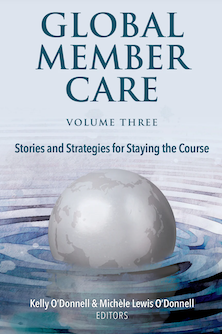
Global Member Care: Stories and Strategies for Staying the Course edited by Kelly O’Donnell and Michele Lewis O’Donnell. William Carey Publishing, 2024. 380 pages. ISBN-10: 1645085910; ISBN-13: 978-1645085911. Available from William Carey Publishing and Amazon.
Stories and Strategies for Staying the Course is the third volume of Global Member Care series edited by Kelly and Michele O’Donnell. It is a good resource for anyone who is curious about what is going on in the field of member care and how much it has matured. It explores the expansion of what is involved in missions and member care, member care in different regions and different sectors, and staying the course in good practice. This volume describes the collaboration among proponents of member care, and the continuing maturity of non-Western member care approaches that are culturally sensitive and contextualized. Stories of the development of training programs, and how their applications yielded success, abound in this volume.
General Observations
This volume continues to expand on what ought to be included in “missions.” Many parts of the book emphasize collaborating with the purposes of the United Nations to promote the wellbeing of all people and the planet as an important part of the Great Commission. For many readers (including myself), this expands the definition of what missions is and will trigger questions regarding how such cooperation and collaboration can happen in reality without compromising the message of the Gospel and still keeping the good news at the forefront. The emphasis on maintaining integrity, which is addressed by Kelly O’Donnell (193), is an important aspect that needs to be kept in mind when working with others.
A very heartwarming part of this book is the inclusion of stories of cooperation and collaboration resulting in training materials and missionary care activities and movements that have made significant positive impact. Transferring the leadership of member care from Western leaders to those who come from the same ethnicity or nationality as the ones being served is particularly important. Although member care practices and principles may have originally come from Western missions, collaboration has allowed for better contextualization and cultural sensitivity, leading to more useful and meaningful approaches to member care.
Specific to Chinese Member Care
In part two of this volume (beginning from p. 85), which talks about member care in different regions, Chapter 6 (91) by Rainbow Cai and Raymond Yang addresses how to support the wellbeing and effectiveness of Chinese mission workers. The contents are based on Rainbow Cai’s dissertation and both Cai’s and Yang’s experiences of serving Chinese cross-cultural workers. The section of the article on Issues That Impact the Wellbeing and Effectiveness of Chinese Mission Workers clearly describes the challenges facing Chinese missions in the following five areas:
- Mission Development Stages in China. The authors point out that at this early stage of Chinese missions, many cross-cultural workers have a lot of enthusiasm and passion, but are not well-equipped. Many go without clear plans and strategies. Financial support is always a big issue, including using non-viable tentmaking approaches to support their work.
- Chinese Culture and Values: Honor and Shame Culture. The challenges relating to Chinese culture and values—in particular, shame/honor culture—caught my attention, realizing the extent of its influence on the life of a Chinese missionary. They describe how the shame/honor culture affects so many aspects of a missionary’s life, from asking for support and funding and seeking help when one is suffering, to dealing with children’s education and especially defining one’s identity.
- The Relationship between Agencies, Sending Churches, and Mission Workers. Strategic cooperation between churches and agencies is one important challenge. Sometimes the worker is torn between his sending church and his organization and needs to choose which to continue to work with.
- Understanding Host Cultures. Cross-cultural adjustment is one of the challenges that face Chinese workers. Their ability to adapt will determine whether they can continue to serve well in the field. This is another area that requires better preparation.
- Mission Workers’ Skills. In this section, the authors emphasized the importance of some theological training and English language skills as crucial for a Chinese cross-cultural worker to do well in the mission field.
Cai and Yang see Western member care as an excellent reference for Chinese member care practitioners to learn from as they create a contextual member care model for Chinese mission workers (94). After reading the other articles in part two of the book, I can also see that models from other non-Western regions can help in the development of a more suitable and contextualized member care model for Chinese member care. These cultures have greater similarities, in particular, the influence of shame/honor culture. The chapter on Developing Member Care in Indonesia is one example (137). The Chinese can also learn from the Korean (107) and Indian (155) experiences.
What Lies Ahead for Member Care?
This material shows that member care as a crucial part of missions has matured. In fact, it has matured to the extent that Dr. Roni Pruitt, in the editorial for the Global Member Care Network February 2026 newsletter, says it is time to professionalize this field. She says,
Today, Member Care stands at a critical juncture. While the discipline is rich in experience, practice, and global collaboration, one essential element has remained underdeveloped: professional validity and standardization. Without shared standards, credentialing, and professional recognition, the field cannot fully mature. Addressing this gap is the necessary next step—one that moves Member Care from a discipline into a profession.
Whether one agrees with professionalizing member care or not, it is undeniable that member care is no longer an emerging field, particularly for Western sending mission organizations and churches. Yet, for some non-Western sending countries, churches, and mission organizations, member care is still in its infancy or early stages. The exciting part is that in recent years, there is rapid growth happening. For Chinese missions, although Chinese missionaries have been sent out for many years from within China to difficult parts of the world, the importance of member care for these servants is still a somewhat new concept, but it is picking up momentum. Since the publication of this book, many things have happened and continue to happen in the development of Chinese member care. Two colleagues of mine and I, with the contributions of many experienced servants, wrote and compiled a Chinese missionary care handbook entitled Serving Together: Caring for Chinese Missionaries which we hope will contribute to the development of member care for Chinese servants. (Traditional and Simplified versions are available through many bookstore outlets.)
One of the repeated themes in this book, which deserves attention, is having people of the same nationality and background develop and provide member care programs, eventually taking ownership of the ministry of care, and while Westerners gradually decrease their involvement. For the Chinese context, this means raising up Chinese member care providers among the Chinese within China and in the diaspora. It will mean a willingness to start by learning from others, contextualizing the approaches and models to fit the Chinese needs better, and then creating new and unique approaches that are culturally sensitive to the Chinese situation. This volume can be a good place to explore what is already available and how collaboration can be done!