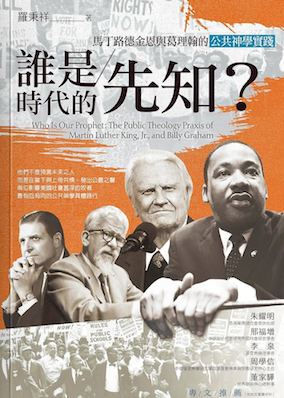
Ping-cheung Lo’s Shui shi shidai de xianzhi?—Mading Lude Jin’en yu Gelihan de gonggong shenxue shijian [Who Is the Prophet of Our Time?: The Public Theology Praxis of Martin Luther King Jr. and Billy Graham] is a voluminous, structurally complex, and highly ambitious work. The book spans nearly six hundred pages. It employs a case-study approach to construct a parallel narrative of two of the most representative religious figures in twentieth-century America, and on this basis develops a systematic reflection on public theology. When evaluated by its overall design and arrangement, the book is not only an academic monograph that intertwines history and theology; it also clearly intends to serve as a textbook on public theology for Chinese churches.
Grand Ambition
The most prominent feature of this book lies in its highly self-aware structural design. The book consists of eight chapters. Each chapter contains historical narrative and concludes with sections such as “Extended Discussion on Public Theology,” “Summary,” and “Questions for Discussion,” forming a highly pedagogical textual format. In the first chapter, for example, the extended discussion is subdivided into five topics: the need for Chinese churches to fully grasp the cautionary lessons of the American church; the case-study method; the relationship between Rabbi Abraham Joshua Heschel and the case studies in this book; the movement from Lausanne and integral mission to public theology; and the argument that public theology should not merely be an application of theology, but a proper theological enterprise with a practical dimension. These topics are especially concerned with the context of Chinese churches, showing the author’s intention to transform historical narrative into resources for theological reflection and classroom discussion.
Although the “extended discussion” sections are labeled as extensions, they in fact often occupy a considerable portion of the book. In the first chapter, this section spans sixteen pages (pp. 27–43), even exceeding the length of the main text (pp. 13–26). Similar patterns appear in other chapters, where the extended sections and the main narrative form a kind of parallel structure. This arrangement means that the book does not simply treat history as primary and theology as secondary. Rather, it attempts to establish a dual axis between narrative and reflection. This style of writing is uncommon in Chinese theological works. It also reflects the author’s attempt to integrate his previous research into a framework of public theology, thereby producing a comprehensive work representative of his scholarship.
From this perspective, the book’s ambition does not stop at introducing public theology. It attempts to define its methodology, practical pathways, and pedagogical form. The appendix’s summary of the definition, characteristics, and methods of “public theology” (pp. 515–527) further reinforces this point. Just as the “extensions” are in fact a parallel track, the “appendix” may also be viewed as the book’s theoretical conclusion.
Comprehensive Development
Another important contribution of this book lies in its detailed reconstruction of the development of Martin Luther King Jr.’s and Billy Graham’s public theology. The book painstakingly traces their thought and action from their early pastoral ministries through key historical moments such as the Civil Rights Movement, the Vietnam War, and the Watergate scandal. This dense narrative allows readers to enter concrete historical situations rather than remaining at the level of abstract theory.
The author does not simply contrast the two men as “prophet” and “priest.” Instead, he presents their interactions, divergences, and transformations within historical tension. For example, their “total split” during the Vietnam War (pp. 370–384), as well as Graham’s later reflections and shifts (pp. 474–481), form a complex dynamic relationship. This treatment shows not only the author’s training in ethics, but also an attentiveness closer to historical description and the theological presentation of tension.
Although the book’s main line of argument narrates and compares the public theology praxis of Martin Luther King Jr. and Billy Graham, its cover also features two figures relatively unfamiliar to many Chinese churches: the Jewish rabbi Abraham Joshua Heschel and the evangelical theologian Carl F. H. Henry, the first editor-in-chief of Christianity Today. The book devotes considerable space to Heschel’s theological vision (pp. 30, 334–344, 398–419, 489–494) as a point of comparison, and it also traces Christianity Today’s changing attitude toward Martin Luther King Jr. (pp. 18, 184–188, 275–282, 327–331, 384–387, 435–439, 481–487). These supporting figures are not merely interesting; they are almost indispensable frames of reference for the book. This is another important feature of the work.
Multiple Goals
The difficulty of writing this book is extremely high, involving tensions across at least three dimensions. It must possess research value while also being suitable for classroom teaching, and therefore it must balance the functions of an academic monograph and a textbook. It is both historical writing and theological reflection, and therefore it must organically combine narrative and argument. At the same time, the author strives to balance professional depth and accessibility: he must maintain the theoretical depth of theology and ethics while also making the book understandable to non-specialist readers, so that it can function as an introductory and popular work on public theology.
In terms of its overall effect, the author largely succeeds in achieving this balance. His narrative is fluid, and he is especially skilled at controlling pace. The writing even carries a distinct cinematic quality, advancing historical scenes like a documentary or screenplay. This is particularly evident in the descriptions of key events in the Civil Rights Movement, such as the Montgomery Bus Boycott in chapter 2 and the “Letter from Birmingham Jail” in chapter 5. The inner drama of certain figures is also compelling, such as King’s movement from reluctant participation to wholehearted commitment in the Civil Rights Movement (pp. 52–58), and Graham’s strategic compromises and political calculations regarding segregation during his crusades in the American South (pp. 120–133).
Yet the success of these multiple goals also brings an unavoidable cost: the sprawling nature of the text. When historical narrative, theological reflection, pedagogical design, and conceptual explanation unfold simultaneously, the book’s center of gravity becomes difficult to hold. Readers may easily experience fatigue, as though they are constantly switching channels.
The Risk of Losing Focus
For this reason, the book presents several points worthy of reflection.
First, its structural overexpansion weakens the concentration of the argument. From the perspective of a textbook, the amount of information may also exceed what an ordinary classroom can bear.
Second, the book’s genre positioning is ambiguous. It resembles a historical work, a theological treatise, and a textbook at the same time, yet no clear hierarchy among these three functions emerges. This strategy of trying to do everything makes the book difficult to categorize and, to some extent, affects its pathways of reception and dissemination.
Third, there is a tension between narrative density and theoretical distillation. The detailed historical descriptions certainly strengthen the sense of immediacy, yet they also compress the space for theoretical abstraction and conceptual construction. Readers can “see” how public theology happens, but they may not always clearly grasp its theoretical contours. At times, they may become absorbed in the story and lose sight of the theoretical framework. In this sense, the theoretical dimension of public theology appears relatively thin and almost seems to occupy the position of an appendix.
Implications for Chinese Churches
Of course, our concern with this book is not limited to its scale or structural challenges, but also to how it helps Chinese churches today reflect on their witness in public contexts. This, after all, is also the author’s purpose.
For many Chinese Christians who are thinking about the relationship between faith and public life, the importance of this book lies not only in helping readers gain a fuller and deeper understanding of the intellectual journeys of two well-known American religious leaders, including the tensions and changes within those journeys. More importantly, it offers a mirror: when the church faces political pressure, social injustice, and the crises of the times, how should it discern what constitutes gospel-shaped public witness? What is a truly prophetic voice? And how can it avoid reducing prophetic witness to a political position, or retreating from gospel witness into private faith?
Overall, Who Is the Prophet of Our Time?: The Public Theology Praxis of Martin Luther King Jr. and Billy Graham is undoubtedly a landmark work of Chinese-language public theology. It reaches a considerable height in its integration of historical sources, narrative ability, and interdisciplinary synthesis. In my view, it has indeed achieved its writing aims: it is at once a rigorous and detailed academic work, a vivid and moving historical biography, and an introductory text and classroom resource for public theology. It provides an important and rare starting point for Chinese churches to enter into discussions of public theology.